

Luzon · Cordillera Administrative Region
Banaue
The gateway to the Ifugao rice terraces, a World Heritage landscape of hand-carved amphitheatres and mountain villages.

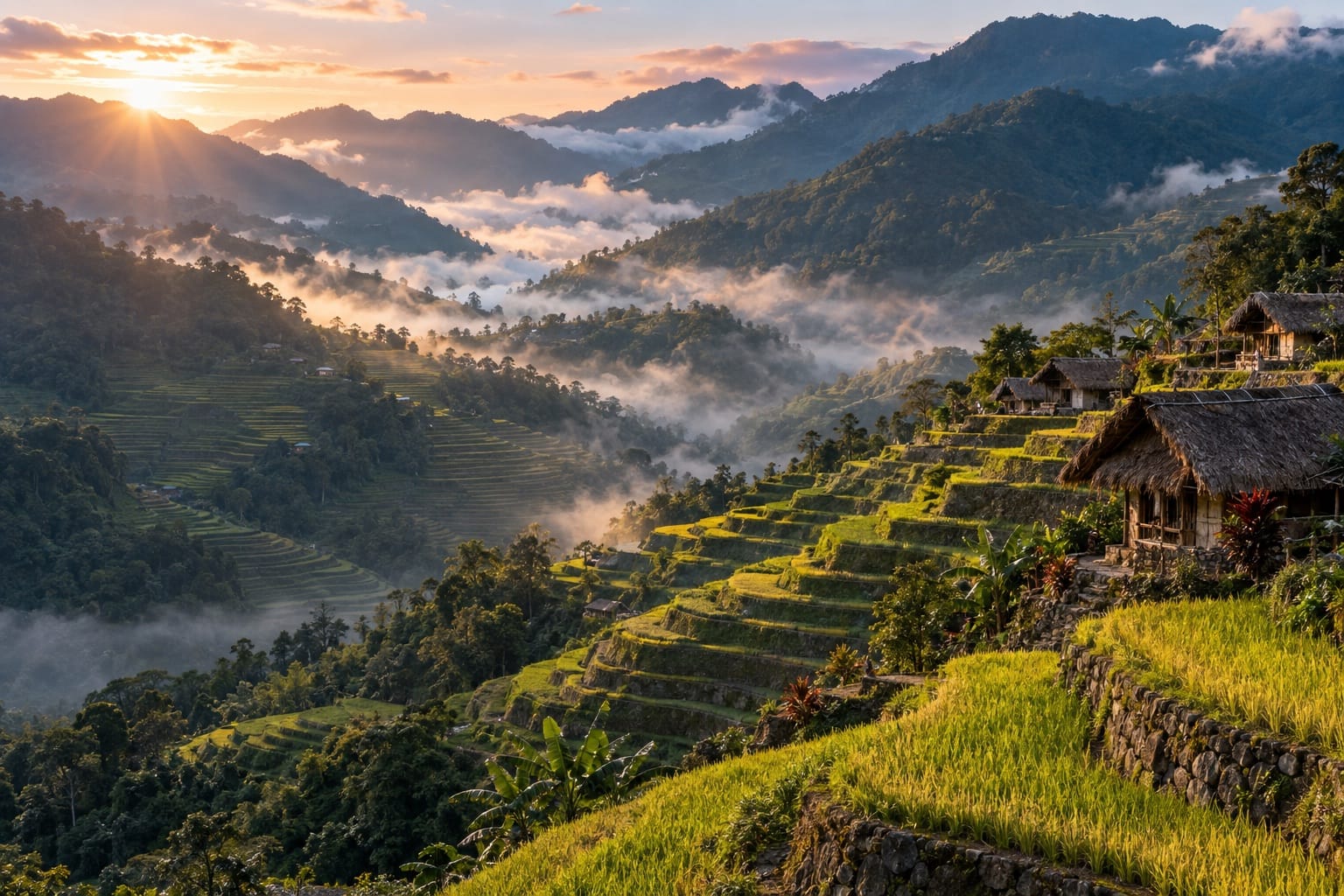
Overview
Banaue is the main gateway to the Ifugao rice terraces, a UNESCO World Heritage cluster carved into the mountains over more than two thousand years. The town itself has roadside viewpoints and a small Ifugao museum, but the memorable walks are in the villages around it, above all Batad, where the terraces form a deep amphitheatre around a compact village and the Tappiya Falls drop at the valley floor. Bangaan and Hungduan offer quieter terrace landscapes for travelers with more time.
Standout experiences
Batad amphitheatre
A steep walk down into the terraced village and its viewpoints, the classic Ifugao scene.
Tappiya Falls
A demanding valley-floor trek through the terraces to a wide waterfall pool.
Banaue viewpoints and museum
Roadside decks and the town museum, an easy introduction for travelers who would rather not trek.
Bangaan and Hungduan
Quieter World Heritage terraces beyond Batad for travelers who want to avoid the crowds.
Ifugao villages and food
Lodge meals of local rice and Ifugao dishes, and craft stops along the terraces.
Getting there
Banaue has no commercial airport. The closest is Cauayan Airport (CYZ) in Isabela, served by Cebu Pacific and PAL Express from Manila, followed by a van or bus ride of about three to four hours. Overnight buses from Metro Manila reach Banaue in eight to ten hours, and travelers also connect through Baguio or Bontoc.
When to go
The rice terraces change with the farming cycle, so timing shapes the view. The dry season from December to May gives clearer trails and firmer roads, while the June-to-November rainy season brings landslides and difficult mountain driving. Mountain temperatures from November to mid-February can fall to about 5 degrees Celsius, so warm layers matter even in the tropics.
More in Luzon
Bataan (Morong)
Central Luzon
A peninsula of World War II memory, heritage towns, and quiet beaches within easy reach of Manila.
Batanes
Cagayan Valley
The country's northernmost province, a green archipelago of stone villages, cliffs, and sweeping coastal views.
Batangas
CALABARZON
The closest beach and dive province to Manila, from Anilao reefs to Laiya sands and Taal heritage.